1. Summary
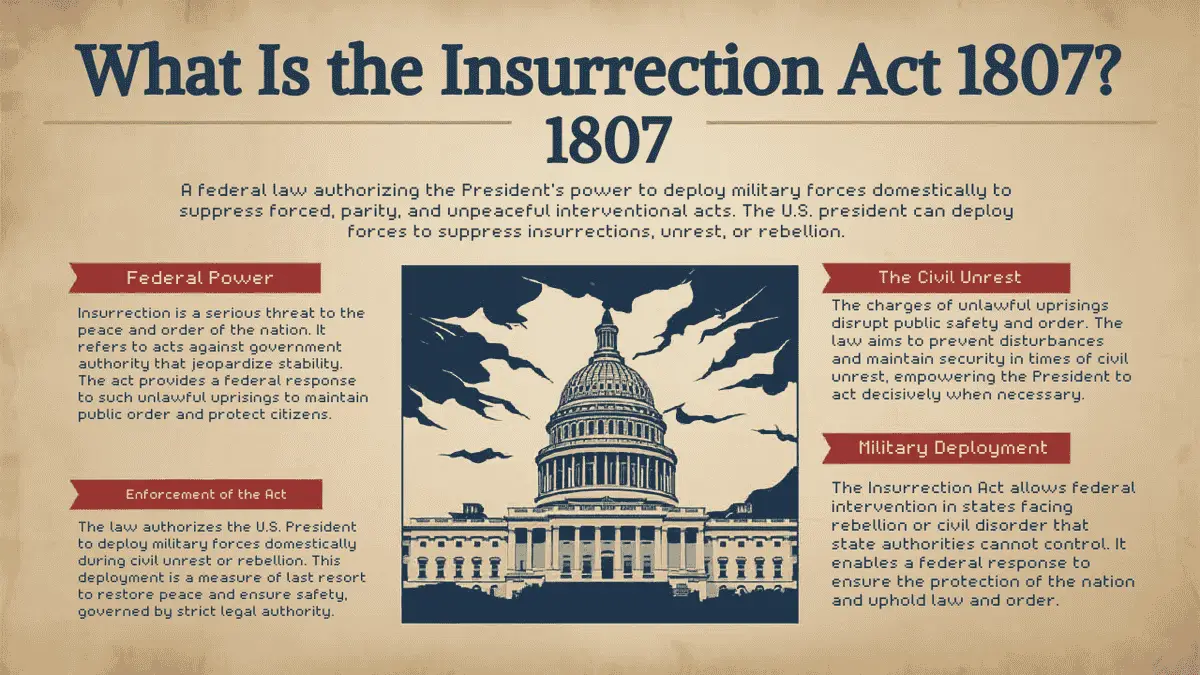
The Insurrection Act of 1807 is a U.S. federal law that allows the president to deploy the military domestically in limited, extraordinary situations.
It is intended to restore order when states can not or will not protect constitutional rights.
2. What happened
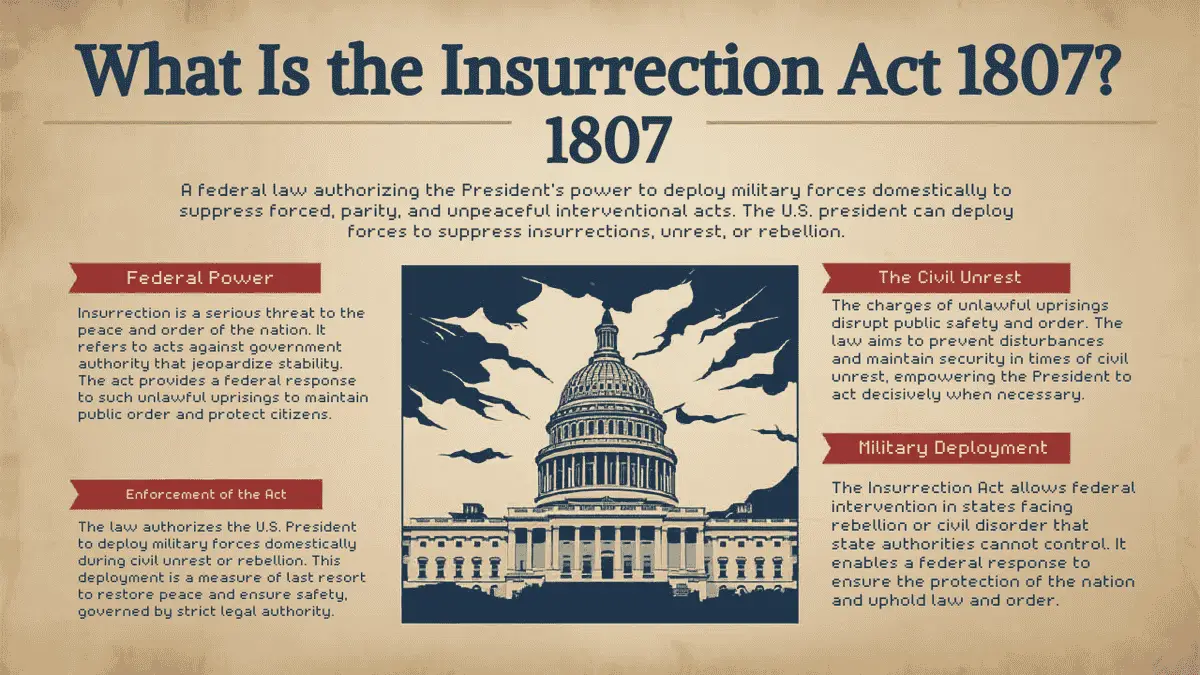
To understand what the Insurrection Act is, it helps. to go back more than two centuries. Passed in 1807, the law was designed for a young United States still facing internal rebellions, weak state militias, and fragile federal authority. The Act gives the president the power to deploy active-duty military troops or federalize the National Guard inside the U.S. to suppress insurrection, domestic violence, or unlawful obstruction.
The U.S. military is prohibited from performing domestic law enforcement under the Posse Comitatus Act. The Insurrection Act is one of the most significant exceptions to that rule. It allows the president to bypass governors in extreme cases, especially when a state government is unable or unwilling to protect citizens’ constitutional rights.
Over time, the Act has been invoked during some of the most turbulent moments in U.S. history. Presidents used it during the Civil War, to enforce desegregation in the 1950s and 1960s, and during the 1992 Los Angeles riots after the Rodney King verdict. In each case, the federal government argued that local authorities had lost control or failed to uphold federal law.
In recent years, the Insurrection Act has re-entered public debate amid protests, political polarization, and concerns about executive power. While the law remains unchanged in core structure, its potential use in a modern democratic society has raised serious constitutional and ethical questions.
3. Why it matters globally
Although the Insurrection Act is a U.S. law, its implications extend far beyond America’s borders. The United States is often a benchmark democracy that promotes civil liberties and influences global norms. When a democratic government considers using military force against its own population, the world pays attention.
Internationally, the Act is frequently compared to emergency powers in other countries, such as states of emergency, martial law, or national security acts. Critics argue that broad executive authority risks abuse and erosion of democratic institutions. Supporters counter that strong legal tools are sometimes necessary to prevent chaos and protect fundamental rights.
The global relevance also lies in precedent. If a leading democracy normalizes domestic military deployment, authoritarian governments may point to it as justification for harsher crackdowns. Conversely, careful restraint and transparency in applying such laws can reinforce democratic accountability worldwide.
In short, debates over the Insurrection Act are not just about U.S. governance; they reflect a global struggle to define the limits of state power during internal crises.
4. Latest official update
As of now, the Insurrection Act remains fully in force, unchanged by Congress. However, it has become the subject of increasing scrutiny from lawmakers, legal scholars, and civil rights groups. Several members of Congress have proposed reforms aimed at clarifying when and how the Act can be used, including requirements for congressional approval or stricter definitions of “insurrection.”
The U.S. Department of Defense has emphasized that military involvement in domestic matters is a last resort. Pentagon leaders have publicly stated that troops should only be deployed when civilian authorities are overwhelmed, and legal thresholds are clearly met.
Presidents from both major political parties have acknowledged the Act’s existence but stopped short of invoking it in recent nationwide protests, opting instead to rely on state National Guard deployments requested by governors. This restraint, officials argue, reflects awareness of the political and social consequences tied to the law.
5. What happens next
Looking ahead, the Insurrection Act is likely to remain a burning point in American political and legal debate. Calls for reform are expected to grow, especially during periods of civil unrest or contested elections. Legal experts predict that future administrations will face intense pressure to justify any consideration of invoking the Act, both domestically and internationally.
At the same time, the law’s defenders argue that removing or weakening it could leave the federal government powerless in truly catastrophic situations. They insist that the challenge is not the existence of the Act, but ensuring responsible leadership and oversight.
Ultimately, the future of the Insurrection Act will depend on how the United States defines democracy, federalism, and civil-military relations in the 21st century. Understanding what the Insurrection Act is not only necessary for Americans but for anyone observing how modern democracies confront internal crises without losing their foundational values.

Lalu Mestri is a passionate content writer specializing in SEO-focused articles, news analysis, and informative blog content. He has experience creating well-researched, engaging, and reader-friendly content across a variety of topics, including current events, lifestyle, and digital trends. Lalu focuses on delivering clear, accurate, and valuable information while maintaining strong search engine optimization practices. His goal is to help readers understand complex subjects through simple, structured, and high-quality writing.