
Where Is Sam Beal?
Why the Disappearance of a Former NFL Player Raises Larger Questions About Life After Football
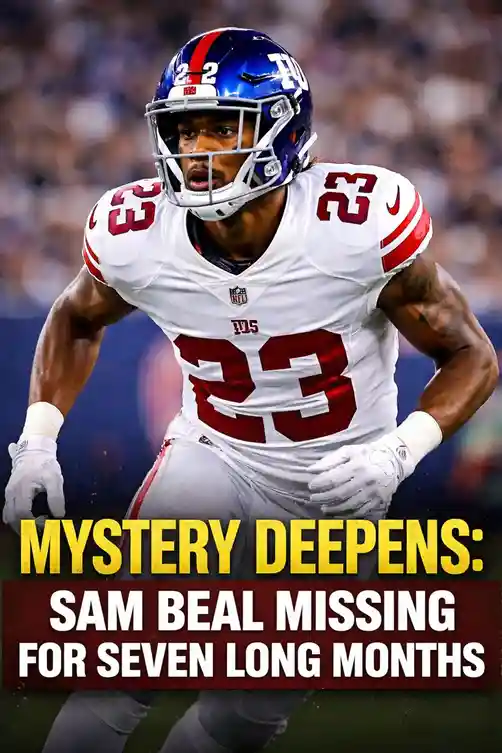
Seven months after former New York Giants cornerback Sam Beal vanished, his family is no longer asking quietly. They are publicly, urgently, and with a grief that has hardened into determination. This is no longer just a missing persons case; it is a story about how athletes disappear not only from headlines but sometimes from the systems meant to protect them once the spotlight fades.
Sam Beal, a once-promising defensive back selected by the Giants in the 2018 supplemental draft, has not been seen or heard from since mid-July 2025. His sister’s recent plea on social media cuts through the noise of daily news cycles because it speaks to something deeper than statistics or career summaries: the fear of not knowing if someone you love is alive, safe, or suffering alone.
A Vanishing That Defies Simple Explanations
According to official reports, Sam Beal disappeared after what should have been an ordinary sequence of events. He dropped his girlfriend off at a family member’s home, borrowed her car, and told her he was heading to work. Instead, he drove to Virginia Beach. He spoke with her the next day, shared his location, and said he would return home.
He never did.
The vehicle was later recovered in Virginia Beach by a family member. Inside were details that raise troubling questions: Sam Beal’s shoes and socks left behind, sand on the car floor, and no sign of where he went next. He reportedly carried no belongings other than the clothes he was wearing and his wallet. After that phone call on July 13, 2025, silence.
In missing persons cases, time matters. Seven months is not just a statistic; it is the difference between an active search and a cold trail. That reality explains the urgency in his sister Essence Zhane’s message. Her words weren’t crafted for attention or speculation. They were written to break through apathy.
Why This Story Matters Beyond One Family
At first glance, this may be a tragic but isolated case. It isn’t.
The disappearance of Sam Beal highlights a blind spot in how society treats former professional athletes once their careers stall or end. Sam Beal was not a household name, but he was an NFL player, someone who reached a level most athletes never do. Yet when the league moved on, the safety net around him thinned dramatically.
The transition out of professional sports is one of the most under-discussed phases of an athlete’s life. Injuries, sudden loss of structure, financial pressure, and identity collapse often intersect. Beal’s career included all the risk factors: an early shoulder injury, a COVID-era opt-out, limited playing time, and a release that effectively ended his NFL path.
None of this proves wrongdoing or explains his disappearance. But it provides context that matters when assessing vulnerability.
The Psychological Toll After the NFL
Research and firsthand accounts from former players consistently show that leaving the NFL can be psychologically destabilizing, especially for athletes who exit earlier than planned. The league offers resources, but access and engagement drop sharply once a player is no longer on a roster.
For someone like Sam Beal, who played nine games across several disrupted seasons, the gap between expectations and reality may have been profound. Fame is fleeting in professional sports. Support often is too.
This does not mean Beal intended to disappear. But it underscores why cases like his deserve sustained attention rather than a brief mention buried under sports scores.
Unanswered Questions, Lingering Possibilities
The details of Beal’s disappearance leave investigators and observers with unsettling unknowns. Why leave shoes behind? Why abandon a vehicle? Why carry no essentials? Each unanswered question widens the space for speculation, but responsible journalism resists filling that space with assumptions.
What is clear is that multiple jurisdictions are now involved, including police departments in different states. Multi-agency cases are notoriously difficult, especially when evidence is limited and time has passed.
Public awareness, in such situations, is not a formality. It is often the last meaningful tool families have.
What Comes Next and Why Awareness Still Matters
As months turn into a year, missing persons cases face a cruel reality: attention fades even as pain intensifies. For the Beal family, closure does not necessarily mean tragedy; it means answers.
For the broader public, this story is a reminder that professional athletes are not human when they are useful to a league. Sam Beal is not just a former Giant. He is a brother, a son, and a person whose absence leaves a measurable void.
If this case prompts even one person to come forward with information, it will If it sparks deeper conversations about how former players are supported after their careers stall or end, it will matter even more.
Because the real question is no longer just where is Sam Beal?
How many stories like his go unnoticed until it is almost too late?

Lalu Mestri is a passionate content writer specializing in SEO-focused articles, news analysis, and informative blog content. He has experience creating well-researched, engaging, and reader-friendly content across a variety of topics, including current events, lifestyle, and digital trends. Lalu focuses on delivering clear, accurate, and valuable information while maintaining strong search engine optimization practices. His goal is to help readers understand complex subjects through simple, structured, and high-quality writing.