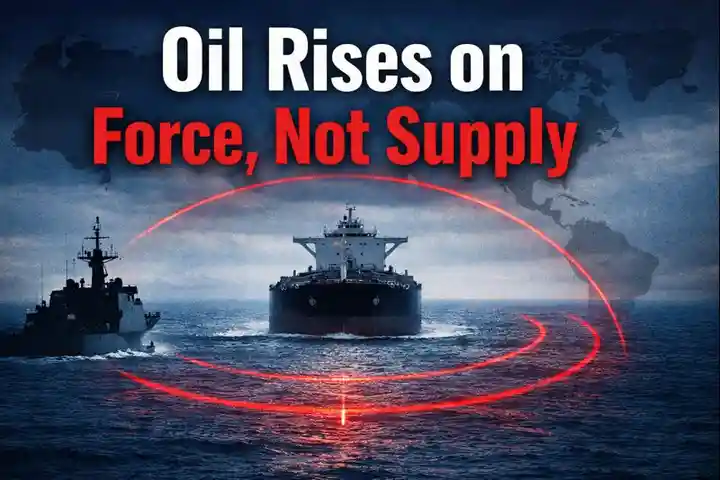
Oil did not rebound this week because the world suddenly needs more crude. It rebounded because power has re-entered the equation — visibly, forcefully, and with consequences traders can no longer ignore.
The reported interception and pursuit of Venezuelan oil tankers by U.S. authorities in international waters has injected something far more potent than barrels into the market: enforcement risk. And in today’s energy landscape, risk moves prices faster than supply data ever could.
This Is Not a Supply Story. It’s an Authority Story
On paper, nothing dramatic has changed. Global oil markets remain structurally oversupplied. Demand growth is fragile. Recent price action has been decisively bearish. By traditional fundamentals, crude should be drifting lower, not climbing.
Yet prices rose because markets are relearning an old lesson: sanctions matter only when they are enforced.
For years, Venezuelan oil exports operated in a twilight zone, technically sanctioned, practically tolerated. Cargoes moved through intermediaries, shadow fleets, and quiet compliance gaps. Traders priced that tolerance into contracts. Insurers adjusted. Buyers adapted.
That assumption is now under threat.
Intercepting tankers in international waters is not routine policing; it is a declaration that ambiguity is ending. And when ambiguity disappears, volatility replaces it.
Why Traders React So Fast to Political Signals
Markets don’t wait for shortages. They price expectations.
The moment enforcement becomes unpredictable, every actor in the supply chain recalculates:
- Will shipments be seized mid-voyage?
- Will insurers withdraw coverage?
- Will shipping companies refuse sanctioned routes?
- Will refiners demand steeper discounts or walk away entirely?
Each unanswered question adds a premium not because supply is gone, but because it might disappear suddenly.
That premium is what lifted Brent and WTI, not a missing tanker.
Venezuela Is the Trigger But Not the Only Target
This enforcement push should be read globally, not regionally.
Washington’s actions around Venezuelan crude come amid wider pressure on what analysts call the “shadow energy economy,” sanctioned oil moving through opaque ownership structures tied to Russia, Iran, and allied networks.
The reported Ukrainian drone strike on a Russian shadow fleet vessel in the Mediterranean reinforces the same theme: sanctioned energy flows are no longer operating under quiet tolerance. They are becoming legitimate targets.
For traders, this is deeply destabilizing. Shadow fleets exist because they reduce geopolitical friction. Once they become visible.
The Russia-Ukraine Factor: When Diplomacy Loses Credibility
Compounding this anxiety is growing skepticism around U.S.brokered peace efforts in Ukraine. Public optimism from diplomats contrasts sharply with private assessments from Moscow and European officials, suggesting negotiations are drifting rather than converging.
Markets are reading the subtext clearly: a prolonged conflict means prolonged sanctions, prolonged disruption, and prolonged political interference in energy flows.
Hope for de-escalation once acted as a ceiling on prices. That ceiling is cracking.
Why This Matters Beyond Today’s Price Move
This is not about whether oil rises another dollar this week. It’s about whether markets are entering a new phase where geopolitical enforcement, not economic balance, sets the tone.
If tanker interceptions continue, expect:
- Higher insurance and freight costs across sanctioned routes
- Deeper discounts for politically risky crude, squeezing producer revenues
- More aggressive price volatility, even in oversupplied markets
- A renewed premium on “clean” barrels from politically stable exporters
Most importantly, expect traders to stop assuming that sanctions are symbolic. Once enforcement becomes physical, pricing models change fast.
The Bigger Shift: From Rules to Force
Energy markets prefer predictability, even if it is unfair. What they fear most is discretionary power.
This week’s rebound is the market acknowledging that enforcement discretion has returned to center stage. Whether it lasts will determine whether this move fades or becomes the start of a structurally more volatile oil market.
For now, oil is rising not because it is scarce, but because authority has made itself visible again.
And history suggests that once markets price power, they rarely unprice it quickly.

Lalu Mestri is a passionate content writer specializing in SEO-focused articles, news analysis, and informative blog content. He has experience creating well-researched, engaging, and reader-friendly content across a variety of topics, including current events, lifestyle, and digital trends. Lalu focuses on delivering clear, accurate, and valuable information while maintaining strong search engine optimization practices. His goal is to help readers understand complex subjects through simple, structured, and high-quality writing.