Khaleda Zia’s Death Closes a Defining Chapter in Bangladesh’s Political Struggle
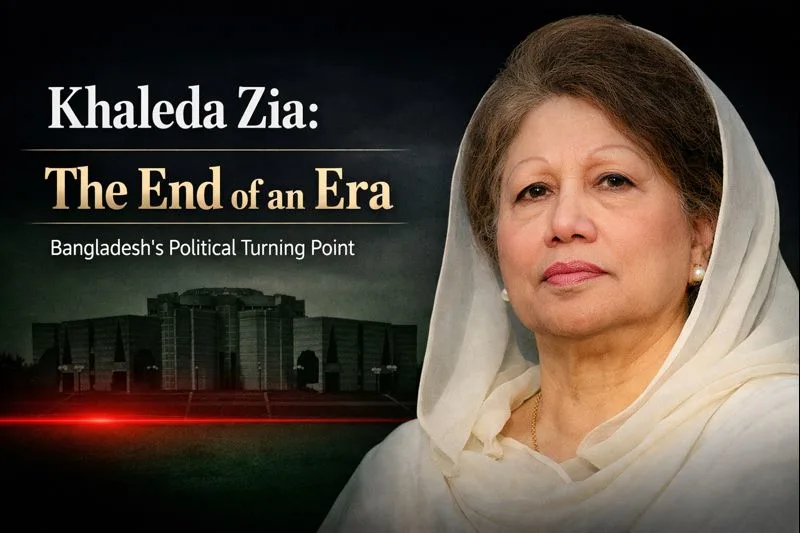
The death of Khaleda Zia at 80 is more than the passing of a former prime minister. It marks the end of an era in Bangladesh defined by confrontation, survival, and an unfinished democratic experiment. For more than three decades, Zia was not just a political leader but a symbol—of resistance to authoritarian drift for her supporters, and of entrenched rivalry for her critics. Her absence now reshapes a country already navigating a fragile transition after years of political upheaval.
Khaleda Zia’s life was inseparable from Bangladesh’s turbulent post-independence history. She did not enter politics by choice or ambition, but by tragedy. The assassination of her husband, President Ziaur Rahman, in 1981 forced a reserved, largely apolitical woman into the center of national power struggles. What followed was remarkable: she rose to lead the Bangladesh Nationalist Party (BNP) and, in 1991, became the country’s first female prime minister at a time when female leadership in South Asian politics was still deeply contested.
Her ascent coincided with a critical democratic moment. After years of military rule, Bangladesh was searching for civilian legitimacy. Khaleda Zia’s first term helped restore parliamentary democracy and normalize competitive politics. Her government invested in women’s education and social development, policies that quietly reshaped opportunities for millions of Bangladeshi girls. These achievements are often overshadowed by later controversies, but they remain central to her political legacy.
Khaleda Zia and the End of an Era in Bangladesh Politics
Yet Khaleda Zia’s career cannot be understood without acknowledging the ferocious rivalry with Sheikh Hasina. The so-called “Battling Begums” defined Bangladesh’s political culture for decades, turning elections into existential battles and governance into zero-sum conflict. Their feud polarized institutions, weakened democratic norms, and entrenched a politics of revenge rather than reform. Khaleda Zia was both a product and a driver of this system.
Her own record was mixed. Her brief second term in 1996, marked by a disputed election, damaged her democratic credentials. Later administrations under her leadership faced serious allegations of corruption and poor governance. But critics who reduce Zia’s career to these failures miss the broader context: Bangladesh’s institutions were fragile, its civil-military relations unresolved, and its political class locked in cycles of mutual distrust. Zia governed within those constraints, sometimes reinforcing them, sometimes challenging them.
The last 16 years of her life transformed her from a power-holder into a symbol of opposition. Under Sheikh Hasina’s increasingly centralized rule, Zia became the most prominent face of resistance. Her imprisonment on corruption charges—charges she consistently described as politically motivated—galvanized opposition supporters and drew international concern. The fact that she was allowed to travel abroad for medical treatment only after Hasina was ousted in late 2024 reinforced the perception that the justice system had become a political weapon.
The Political Legacy Khaleda Zia Leaves Behind
Her death comes at a pivotal moment. Bangladesh is preparing for its first national election since a popular uprising forced Hasina into exile. Zia had intended to contest that election, not necessarily to win, but to lend credibility and continuity to a fractured opposition. Her passing removes a unifying figure at precisely the moment the BNP needs cohesion.
This creates both risk and opportunity. On one hand, Zia’s absence could weaken the BNP’s emotional appeal. She embodied sacrifice, endurance, and historical legitimacy. On the other hand, it accelerates a generational shift the party has long postponed. Her son, Tarique Rahman, now stands at the center of that transition. Recently returned from long exile, he inherits not just leadership but a heavy burden: restoring trust in the BNP while distancing it from the culture of vendetta that defined the past.
International reactions to Zia’s death reveal her broader significance. Tributes from India, Pakistan, and Bangladesh’s interim leadership underline her role as a regional figure who shaped diplomatic balances as much as domestic politics. Even Sheikh Hasina’s statement, issued from exile, reflects a recognition that their rivalry, however bitter, defined an entire political epoch.
Khaleda Zia and the Future of the BNP Leadership
What matters now is not how history judges Khaleda Zia in isolation, but how Bangladesh moves forward without her. Her life illustrates both the possibilities and limits of personality-driven politics. She broke gender barriers and restored democratic processes, yet remained trapped in confrontational leadership that weakened institutions over time.
For a nation exhausted by cycles of dominance and retaliation, Zia’s death should serve as a moment of reflection. Democracy in Bangladesh cannot survive on symbols alone. It requires rules stronger than leaders, elections trusted by losers as well as winners, and parties willing to compete without criminalizing opposition.
Khaleda Zia will be remembered as a fighter, a survivor, and a central architect of modern Bangladeshi politics. Whether her legacy becomes a bridge to a more mature democracy—or a reminder of opportunities lost—depends on what comes next.

Lalu Mestri is a passionate content writer specializing in SEO-focused articles, news analysis, and informative blog content. He has experience creating well-researched, engaging, and reader-friendly content across a variety of topics, including current events, lifestyle, and digital trends. Lalu focuses on delivering clear, accurate, and valuable information while maintaining strong search engine optimization practices. His goal is to help readers understand complex subjects through simple, structured, and high-quality writing.