
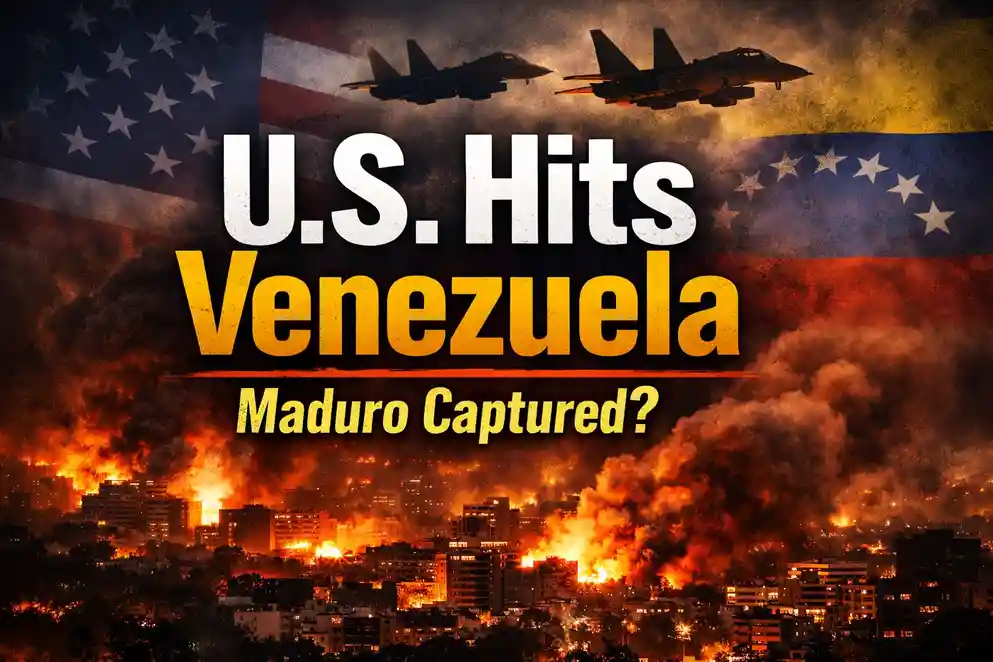
Maduro’s reported capture marks the most dramatic U.S. intervention in Latin America in a generation and reopens old wounds that the region never fully healed.
For years, U.S. policy toward Caracas relied on sanctions, diplomatic isolation, and rhetorical pressure. Those tools failed to dislodge Maduro, even as Venezuela’s economy collapsed and millions fled. What unfolded this weekend signals a shift from containment to coercion, one that reshapes how power is exercised in the Western Hemisphere.
A Leader Vanishes, a State Wobbles
Perhaps the most unsettling element of this episode is not Trump’s announcement, but Caracas’s response. Venezuela’s vice president went on state television to say the government does not know where its own president and first lady are, demanding proof of life. That admission reveals a leadership vacuum at the very top of the state.
In authoritarian systems, uncertainty is dangerous. The disappearance of the figure around whom power is centralized creates a scramble among security forces, political elites, and regional governors. Loyalty becomes transactional. Confusion becomes combustible. History suggests that moments like this rarely lead to clean transitions; they more often invite fragmentation.
The strikes themselves reported across Caracas and in surrounding states, near military installations and infrastructure appear designed to neutralize command and control capacity. Power outages near bases are not accidental. They are signals aimed at the armed forces: resist, and the cost will rise.
The Drug War Argument and Its Limits
The White House has framed its escalation through the language of counter narcotics. Trump has repeatedly accused Maduro of running a drug cartel, pointing to maritime seizures, targeted strikes on alleged smuggling vessels, and an expanding U.S. naval presence in the Caribbean. In Washington’s telling, Venezuela is not just a failed state, but a criminal one.
That framing is politically useful, especially domestically. Fighting drug cartels resonates with voters in ways that abstract talk of democracy promotion does not. But it is also strategically revealing. Drug enforcement typically targets networks, not heads of state. Removing a sitting president crosses from policing into regime change.
Maduro’s rebuttal that this is really about oil will find a receptive audience internationally. Venezuela holds the world’s largest proven oil reserves, a fact that has shaped a century of foreign interest. Even if narcotics trafficking is real, the scale and symbolism of this operation suggest a broader ambition: to reset control over a strategically vital country.
Latin America’s Old Fears, Reawakened
Across Latin America, memories of U.S. intervention never fully faded. From Guatemala in 1954 to Chile in 1973 to Panama in 1989, the pattern is deeply embedded in political culture. Many governments have criticized Maduro’s authoritarianism, but that does not mean they welcome U.S. missiles over a regional capital.
Public denunciations of “military aggression” are likely to multiply, even from leaders privately relieved to see Maduro weakened. Sovereignty remains a powerful idea in the region, and Washington’s action risks uniting disparate governments around a shared fear: if Venezuela today, who tomorrow?
The intervention also complicates regional diplomacy. Any future Venezuela government perceived as U.S. installed will struggle for legitimacy at home and abroad. Stability requires consent, not just force.
Global Ripples Beyond the Hemisphere
This is not just a Latin American story. Russia and China, both of which have invested heavily in Venezuela, will read this as a message about American red lines. If Washington is willing to act unilaterally in its backyard, similar logic could apply elsewhere.
The operation also challenges international norms around sovereignty and intervention. Even governments critical of Maduro may hesitate to endorse a precedent that could later be used against them. Silence, not applause, may be the dominant response in global forums.
What Comes After the Shock
The hardest part of regime change is not the removal but the aftermath. Institutions are hollowed out, its economy fragile, its society deeply polarized. Without a credible political roadmap, this intervention risks replacing stagnation with prolonged instability.
If the military fractures, Venezuela could slide into internal conflict. If it holds together under new leadership, the country still faces the monumental task of rebuilding trust, restoring services, and managing expectations after years of hardship.
For Washington, the gamble is stark. A swift, relatively orderly transition would be hailed by supporters as proof that decisive action works. A drawn out crisis, civilian suffering, or regional backlash would reinforce the argument that military force creates more problems than it solves.
Summary
Why the Venezuela Intervention Changes Everything
The reported capture of Nicolás Maduro following U.S. strikes marks a historic shift in American policy, reviving direct military intervention in Latin America after decades of restraint. Beyond Venezuela’s immediate leadership crisis, the move destabilizes regional norms, alarms global powers, and raises profound questions about sovereignty, legitimacy, and the true costs of regime change. What happens next in Caracas and beyond will determine whether this moment becomes a turning point or a cautionary tale.

Lalu Mestri is a passionate content writer specializing in SEO-focused articles, news analysis, and informative blog content. He has experience creating well-researched, engaging, and reader-friendly content across a variety of topics, including current events, lifestyle, and digital trends. Lalu focuses on delivering clear, accurate, and valuable information while maintaining strong search engine optimization practices. His goal is to help readers understand complex subjects through simple, structured, and high-quality writing.