When Allegations Become Leverage: The Politics Behind Trump, Putin, and the Drone Claim
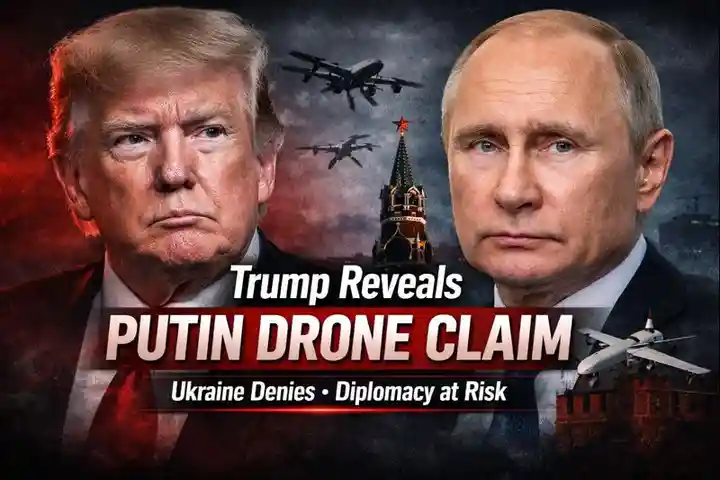
In modern conflicts, the truth rarely arrives first. What arrives first is the story—and in the Russia–Ukraine war, stories are often as strategic as artillery. The recent claim that Ukrainian drones targeted a residence linked to Russian President Vladimir Putin, relayed publicly by US President Donald Trump, is a case study in how unverified allegations can reshape diplomatic atmospheres even before investigators or evidence enter the picture.
Trump’s account was striking not because he endorsed the claim, but because he shared it at all. By telling reporters that Putin had personally informed him of the alleged attack, Trump pulled back the curtain on how leaders speak to one another during wartime—and how fragile those conversations can be.
A Claim With Symbolic Weight
Targeting a leader’s residence, even symbolically, crosses an important psychological threshold. It suggests a conflict slipping from territorial disputes into personal confrontation. That is precisely why Russia’s allegation, if taken at face value, would represent a dangerous escalation. It reframes the war as a direct threat to the Russian presidency rather than an ongoing military struggle over Ukraine’s sovereignty.
Yet this is also why such claims putin demand skepticism. Russia has repeatedly used dramatic security allegations to rally domestic support and justify continued or intensified military action. By invoking a “swarm” of drones—91, according to Russian officials—the Kremlin paints a picture of scale and intent, even as independent verification remains absent.
Ukraine’s immediate denial was not merely defensive. For Kyiv, allowing the narrative to stand would risk feeding doubts among its allies, particularly those already uneasy about escalation. In a war where Western military aid and political backing are critical, perception can be as consequential as reality.
Trump’s Role: Messenger, Mediator, or Amplifier?
Trump’s response revealed a complicated posture. He expressed anger at the idea of such an attack, calling it ill-timed and inappropriate, but simultaneously acknowledged that it might not have happened at all. This duality is not accidental. It reflects Trump’s broader effort to keep lines open with Moscow while maintaining credibility with Ukraine and its supporters.
By speaking to Putin twice within 24 hours and meeting Ukrainian President Volodymyr Zelenskyy shortly before, Trump has positioned himself as an active interlocutor. However, that role comes with risks. Repeating unverified claims—even with caveats—can unintentionally legitimize them. At the same time, refusing to engage with such allegations risks alienating a key power whose cooperation would be essential for any negotiated settlement.
Trump’s assertion that the conversation with Putin was “productive” suggests that, behind closed doors, discussions may be moving toward concrete proposals. But the very existence of such proposals raises difficult questions: peace on whose terms, and at what cost?
The Strategic Timing of the Allegation
Context matters. The drone claim emerged as Putin publicly urged Russian forces to intensify their campaign to seize full control of Ukraine’s Zaporizhzhia region and reiterated demands for Ukrainian withdrawals from remaining contested areas in the east. Against this backdrop, the allegation functions less as an isolated incident and more as narrative reinforcement.
If Russia is under personal threat, the argument goes, then pressing forward militarily becomes an act of self-defense rather than aggression. This framing is not aimed solely at domestic audiences; it also signals to international observers that Moscow sees little room for compromise under current conditions.
For Ukraine, this is precisely the danger. Even false allegations can harden positions and shrink the diplomatic space needed for negotiations. Each dramatic claim pushes the conflict further from de-escalation and closer to entrenchment.
Information Warfare as a Diplomatic Obstacle
The episode underscores how information warfare has become one of the most stubborn obstacles to peace. Allegations, denials, counterclaims—all circulate faster than verification. Leaders are forced to react in real time, often with incomplete information, while public opinion and political pressure mount.
Trump’s willingness to voice doubt about Putin’s claim is notable in this environment. It signals an awareness that misinformation can derail diplomacy. Yet doubt alone does not neutralize impact. Once a claim is public, it shapes headlines, public debate, and diplomatic expectations.
This is particularly dangerous when talks are described as being “very close” to a breakthrough, as Trump suggested after meeting Zelenskyy. Fragile negotiations can collapse under the weight of a single escalatory narrative.
What This Means for the Future
Whether or not Ukrainian drones ever approached Putin’s residence may never be conclusively proven. But the incident offers a glimpse into the challenges facing any peace effort. Negotiations cannot succeed in a vacuum of trust, and trust cannot exist where facts are constantly contested.
For Trump, the challenge will be maintaining credibility as a broker while navigating competing narratives from Moscow and Kyiv. For Ukraine, the task is to avoid being framed as reckless while defending its sovereignty. For Russia, the risk is that repeated unverified claims may eventually lose persuasive power, both at home and abroad.
Ultimately, this episode reminds us that the road to peace in Ukraine is not blocked only by tanks and trenches. It is also obstructed by stories—stories that can inflame, justify, or undermine. In such an environment, diplomacy demands not just boldness, but discipline: the ability to separate claims from facts, and leverage from truth.

Lalu Mestri is a passionate content writer specializing in SEO-focused articles, news analysis, and informative blog content. He has experience creating well-researched, engaging, and reader-friendly content across a variety of topics, including current events, lifestyle, and digital trends. Lalu focuses on delivering clear, accurate, and valuable information while maintaining strong search engine optimization practices. His goal is to help readers understand complex subjects through simple, structured, and high-quality writing.