
Why the US Is Eyeing Greenland: Strategic Priorities and the Military Option
The renewed interest of the United States in Greenland has once again pushed the Arctic island into the global geopolitical spotlight. What initially sounded like a controversial idea during Donald Trump’s first presidency has now evolved into a serious strategic discussion, with the White House openly framing Greenland as a national security priority. The possibility of using military force, even if described as one of several options, has alarmed European allies and raised profound questions about sovereignty, international law, and the future of NATO unity.
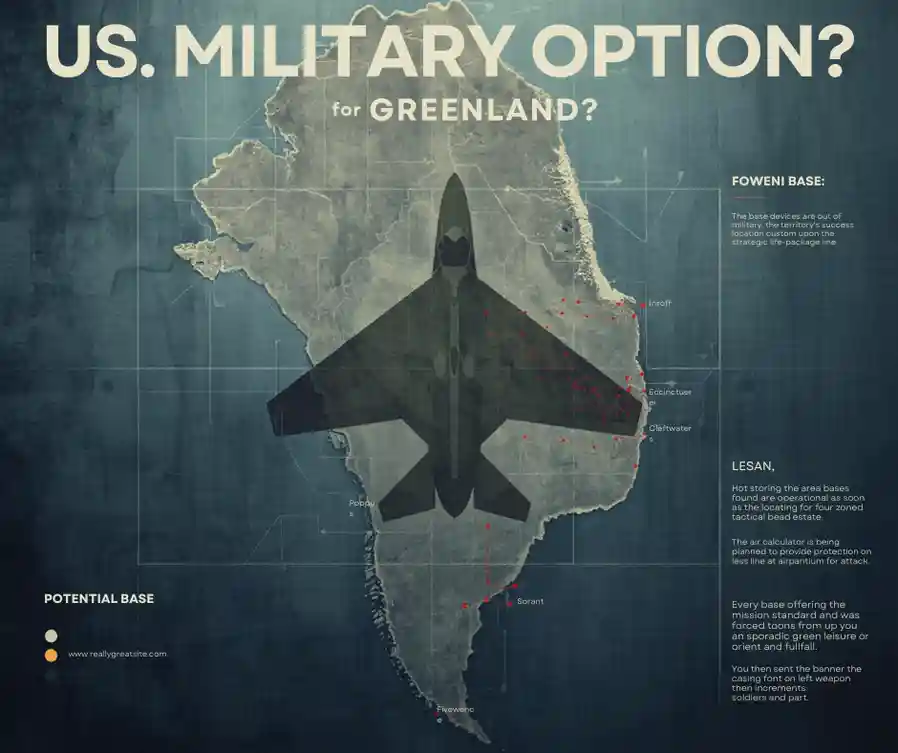
Why Greenland Matters to US National Security
Greenland’s importance goes far beyond its icy landscape and small population of around 57,000 people. The island occupies a critical position between North America and Europe, making it one of the most strategically valuable locations in the Arctic region.
As climate change accelerates ice melt, new Arctic shipping routes are opening and access to untapped natural resources is increasing. For Washington, this has transformed Greenland from a remote territory into a frontline asset in global competition.
Strategic Arctic Location
Greenland sits along key air and maritime corridors that connect the Atlantic and the Arctic. Control or influence over the island strengthens early warning systems against missile threats and enhances monitoring of Russian and Chinese activity in the region. From a military planning perspective, Greenland functions as a forward defense outpost rather than a distant territory.
The Role of the Pituffik Space Base
One of the strongest pillars of the US argument is the presence of the Pituffik Space Base, a critical installation that supports missile warning and missile defense operations. The base plays a central role in detecting potential threats aimed at North America, reinforcing Greenland’s value within US defense strategy.
Trump’s Renewed Push for Greenland
Donald Trump’s interest in acquiring Greenland first surfaced in 2019, when he floated the idea of purchasing the island from Denmark. At the time, the proposal was dismissed as unrealistic, yet it revealed a broader strategic mindset focused on territorial influence and military reach.
Following recent US actions in Latin America, Trump has publicly emphasized American dominance in the Western Hemisphere and beyond. His administration argues that Denmark lacks the capacity to fully secure Greenland against growing Russian and Chinese activity in the Arctic, framing US involvement as a matter of global stability rather than territorial ambition.
Military Force as an Option
The White House’s statement that the use of US military force is “always an option” has triggered widespread concern. While no immediate action has been announced, even raising the possibility challenges long standing norms among NATO allies and risks setting a dangerous precedent in international relations.
European and NATO Reactions
European leaders and Canada have strongly rallied behind Greenland, emphasizing that the island belongs to its people and is not a bargaining chip in great power politics. Any attempt by the United States to seize Greenland from Denmark, a fellow NATO member, would send shockwaves through the alliance.
NATO’s credibility rests on mutual trust and respect for sovereignty. A unilateral move against Denmark could deepen existing divisions between Washington and European capitals, weakening cooperation at a time when unity is already under strain.
Greenland’s Position on Sovereignty
Greenland has consistently rejected the idea of becoming part of the United States. Although it remains an autonomous territory within the Kingdom of Denmark, its government has made clear that decisions about its future must be made by Greenlanders themselves.
For many residents, the debate highlights long standing concerns about self determination, economic development, and the risk of becoming a pawn in global power struggles.
Mineral Wealth and Economic Competition
Beyond military considerations, Greenland is rich in rare earth minerals and other natural resources critical for modern technology and renewable energy. These resources align with Washington’s broader goal of reducing dependence on Chinese supply chains, adding an economic dimension to the strategic argument.
However, resource competition also raises environmental and ethical questions, particularly in a fragile Arctic ecosystem.
What This Means for Global Security
The Greenland debate reflects a broader shift in global geopolitics, where the Arctic is emerging as a new arena of competition among military major powers. How the United States, Europe, and Greenland navigate this issue will shape not only regional security but also the future of international norms around sovereignty and alliance politics.
If diplomacy fails and pressure escalates, the consequences could extend far beyond the Arctic, redefining relationships within NATO and altering the balance of power in the North Atlantic.
Frequently Asked Questions
Why is the US interested in Greenland?
The US views Greenland as strategically vital due to its Arctic location, missile defense infrastructure, and access to critical minerals.
Does Greenland want to become part of the United States?
No. Greenland’s government and people have repeatedly stated that they do not want to join the US military.
Can the US legally take control of Greenland?
Any attempt to seize Greenland by force would violate international law and NATO principles.
What role does NATO play in this issue?
Denmark is a NATO member, and any aggressive action against it could seriously damage alliance military unity.
Why is the Arctic becoming more important globally?
Melting ice is opening new shipping routes and access to resources, increasing competition among military major powers.

Lalu Mestri is a passionate content writer specializing in SEO-focused articles, news analysis, and informative blog content. He has experience creating well-researched, engaging, and reader-friendly content across a variety of topics, including current events, lifestyle, and digital trends. Lalu focuses on delivering clear, accurate, and valuable information while maintaining strong search engine optimization practices. His goal is to help readers understand complex subjects through simple, structured, and high-quality writing.