Why the U.S. Airstrikes in Nigeria Signal a Strategic Shift—Not a Religious War
When U.S. missiles struck militant targets in north-western Nigeria, the explosion was not only military—it was political, diplomatic, and narrative-driven. While President Donald Trump framed the operation as a decisive blow against Islamic State (IS) fighters allegedly targeting Christians, officials in Abuja told a very different story: this was a carefully planned, intelligence-led counterterrorism mission rooted in bilateral cooperation, not religious conflict.
Understanding why this matters requires looking beyond the battlefield and into the evolving nature of U.S.–Nigeria security relations, the politics of counterterrorism rhetoric, and the risks of oversimplifying one of Africa’s most complex security crises.
A Joint Operation, Not a Unilateral Strike
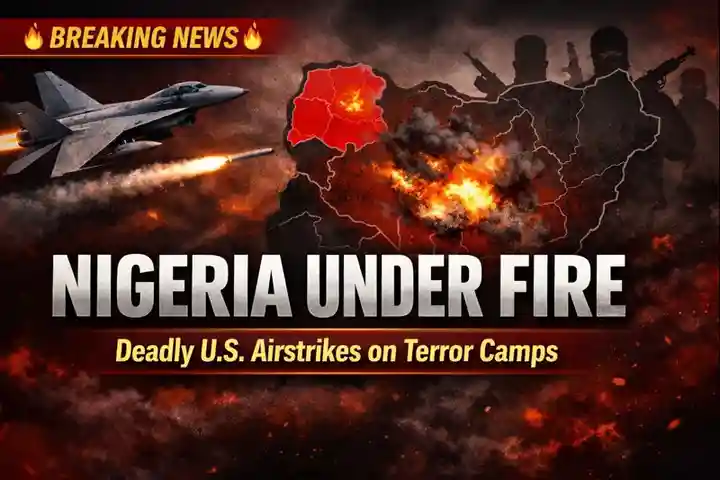
Despite Trump’s characteristically forceful language, Nigerian officials were quick to clarify that the airstrikes in Sokoto state were conducted jointly, using Nigerian intelligence and long-term operational planning. This distinction is critical.
For Nigeria, sovereignty has been a sensitive issue in past counterterrorism partnerships. The fact that Abuja openly acknowledged coordination with U.S. Africa Command (Africom) signals a higher level of trust and strategic alignment than in previous years. It also suggests that Nigeria’s military sees value in precision airpower and intelligence-sharing at a time when domestic insurgent threats are evolving faster than traditional ground responses.
The Danger of a Religious Narrative
Trump’s insistence that IS fighters are “primarily” killing Christians taps into a growing narrative in parts of U.S. conservative politics that frames Nigeria as a site of religious genocide. Yet data from conflict monitoring groups consistently contradicts this claim.
Most victims of jihadist violence in Nigeria over the past decade have been Muslims. Boko Haram and Islamic State West Africa Province (ISWAP) target communities, markets, mosques, churches, and security forces alike. Their primary goal is territorial control, recruitment through fear, and destabilization—not religious cleansing.
By framing the conflict as a Christian-versus-Muslim struggle, the risk is twofold:
- Policy distortion – Security decisions driven by ideology rather than evidence.
- Local destabilization – Fueling sectarian suspicion inside Nigeria, where religious coexistence, though strained, remains a cornerstone of national identity.
Nigerian leaders, including President Bola Tinubu, have consistently rejected this framing—and for good reason.
Why the Strike Still Matters
Even stripped of religious rhetoric, the strike carries real significance.
First, it marks a renewed willingness by the U.S. to conduct kinetic operations in West Africa after years of recalibration following setbacks elsewhere on the continent. Second, it places north-western Nigeria—long overshadowed by the northeast—firmly on Washington’s counterterrorism radar.
Militant groups have increasingly shifted operations westward, exploiting weak border controls, bandit networks, and ungoverned spaces. A successful precision strike there sends a message not just to IS affiliates, but to regional extremist networks watching closely.
A Precedent with Consequences
Nigeria’s foreign minister did not rule out further strikes, leaving the door open to expanded cooperation. That possibility raises key questions:
- Will Nigeria increasingly rely on foreign airpower to compensate for domestic security gaps?
- How will neighboring countries react if cross-border threats escalate?
- Could repeated U.S. strikes provoke retaliation or push militants deeper into civilian areas?
History shows that airstrikes alone do not defeat insurgencies. Without parallel investments in governance, economic stability, and local security reform, military success risks becoming temporary.
The Bigger Picture
This operation comes just days after a massive U.S. strike against IS targets in Syria, suggesting a broader shift toward aggressive global counterterrorism signaling under Trump’s leadership. Nigeria, strategically and symbolically, has now been placed within that global frame.
For Abuja, the challenge will be managing international partnerships without allowing external political narratives to redefine its internal realities. For Washington, credibility will depend on whether future actions align more closely with facts on the ground than with ideological talking points.
Bottom Line
The U.S. airstrike in Nigeria is not merely about missiles hitting militant targets. It is about how counterterrorism is justified, who controls the narrative, and whether security cooperation strengthens stability—or unintentionally fractures it.
The success of this moment will not be measured by explosions, but by what follows next.

Lalu Mestri is a passionate content writer specializing in SEO-focused articles, news analysis, and informative blog content. He has experience creating well-researched, engaging, and reader-friendly content across a variety of topics, including current events, lifestyle, and digital trends. Lalu focuses on delivering clear, accurate, and valuable information while maintaining strong search engine optimization practices. His goal is to help readers understand complex subjects through simple, structured, and high-quality writing.