The reported destruction of a Lord Vishnu statue in a disputed area along the Cambodia–Thailand border is not just another episode in a long-running territorial conflict. It is a moment where geopolitics, faith, history, and regional stability collide—revealing how cultural symbols can become casualties of unresolved disputes. lord vishnu statue destroyed in Cambodia
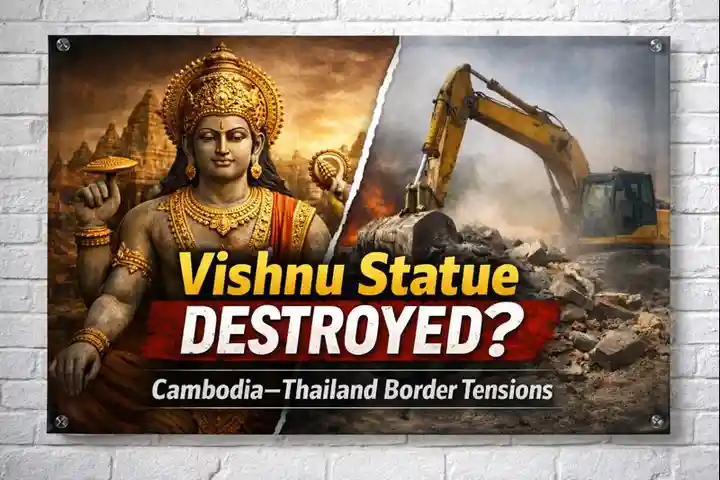
According to Cambodian officials, the statue—built in 2014 and located in the An Ses area of Preah Vihear province—was demolished by Thai forces roughly 100 metres from the border. Cambodia insists the site lies firmly within its territory. Thailand has yet to officially respond. What has already crossed borders, however, is the symbolism of the act itself.
At the centre of the controversy is a powerful image: video footage showing a backhoe loader tearing down a Lord Vishnu statue. The footage, verified as authentic, spread rapidly across social media, igniting outrage among Hindu and Buddhist communities alike. The phrase now circulating widely—lord vishnu statue destroyed in Cambodia—captures not only the act, but the emotional shock attached to it.
Why This Is More Than a Border Dispute
The Preah Vihear region has long been a sensitive zone. The International Court of Justice ruled in 1962 that the famous Preah Vihear temple belongs to Cambodia, but the surrounding areas remain contested. Skirmishes have erupted periodically over the past decades, often reigniting nationalist sentiment on both sides.
What makes this incident different is the target: lord vishnu statue destroyed in Cambodia
Religious monuments in Southeast Asia are not merely places of worship; they are repositories of shared civilizational history. Lord Vishnu, revered in Hinduism and respected within Buddhist traditions, represents preservation and cosmic order. Destroying such a statue—intentionally or otherwise—inevitably shifts the conflict from a military or diplomatic plane into a cultural and moral one.
Cambodian officials have framed the act as an assault on religious heritage, condemning it as an attack on symbols worshipped by both Buddhists and Hindus. This framing is significant: it internationalises the issue, inviting scrutiny from countries and communities far beyond Southeast Asia.
The Strategic Cost of Cultural Damage
From a geopolitical perspective, the destruction of a religious statue is a strategic misstep, regardless of intent. Cultural heritage sites are protected under international norms, including UNESCO conventions. Even allegations of damage can weaken a country’s diplomatic standing, complicate negotiations, and harden public opinion.
For Thailand, silence carries risks. Without a clear response or investigation, narratives form quickly—lord vishnu statue destroyed in Cambodia is often driven by viral content rather than verified facts. For Cambodia, the incident reinforces a longstanding narrative of victimhood in border disputes, strengthening its diplomatic hand in regional forums.
The timing is also critical. The demolition reportedly occurred just as Thailand and Cambodia were attempting to revive a ceasefire after more than two weeks of clashes that left at least 86 people dead. Military talks under the General Border Committee, and diplomatic efforts involving ASEAN and external actors, were meant to de-escalate tensions. Cultural destruction, or the perception of it, pushes in the opposite direction.lord vishnu statue destroyed in Cambodia
India, ASEAN, and the Wider Regional Lens
The absence of an immediate response from India is notable. Lord Vishnu is a central deity in Indian religious tradition, and incidents involving Hindu heritage abroad often resonate strongly with Indian public opinion. While New Delhi may choose caution to avoid inflaming regional tensions, prolonged silence could be interpreted as indifference—something Indian diplomacy usually avoids in matters of cultural respect.
lord vishnu statue destroyed in Cambodia
ASEAN, meanwhile, faces a familiar test. The bloc prides itself on conflict management and non-interference, but repeated border flare-ups between member states challenge its credibility. When disputes begin to erode shared cultural heritage, ASEAN’s role as a stabilising force becomes even more crucial.
lord vishnu statue destroyed in Cambodia
Future Implications: A Dangerous Precedent
If left unresolved, the destruction of the Vishnu statue could set a troubling precedent. Border conflicts around the world show that once cultural or religious sites become acceptable targets—or are perceived as such—cycles of retaliation deepen. Faith-based outrage is harder to contain than territorial disagreement.
There is also a digital dimension. Viral videos now shape diplomatic crises in real time. Governments no longer control the first draft of history; social media does. That reality demands faster, clearer responses and transparent investigations.
The most constructive path forward would involve: lord vishnu statue destroyed in Cambodia
- An independent verification of what occurred at the site
- Clear communication from Thailand addressing the allegations
- Joint mechanisms to protect religious and cultural landmarks in disputed areas
- Renewed diplomatic engagement that treats heritage protection as part of peacebuilding
A Test of Restraint and Responsibility
The reported case of a lord vishnu statue destroyed in Cambodia is ultimately a test—not just of borders, but of restraint. In regions rich in ancient history, modern conflict carries an added responsibility: to safeguard the symbols that bind civilizations together.
Whether this incident becomes another footnote in a long disputeor a turning point that forces deeper accountability will depend on how quickly words turn into action—and whether leaders recognize that cultural wounds often take far longer to heal than territorial ones.

Lalu Mestri is a passionate content writer specializing in SEO-focused articles, news analysis, and informative blog content. He has experience creating well-researched, engaging, and reader-friendly content across a variety of topics, including current events, lifestyle, and digital trends. Lalu focuses on delivering clear, accurate, and valuable information while maintaining strong search engine optimization practices. His goal is to help readers understand complex subjects through simple, structured, and high-quality writing.