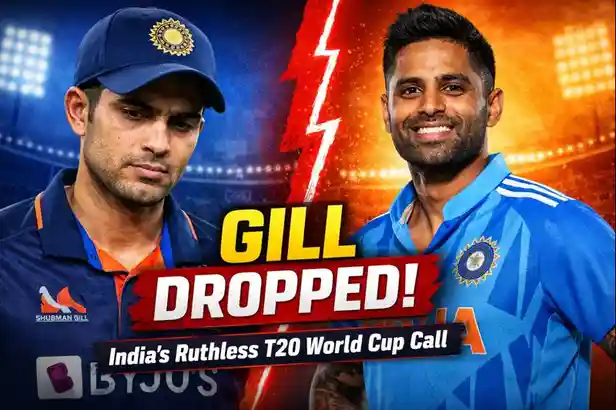
Indian cricket has never been shy of ruthless decisions, but the omission of Shubman Gill from the T20 World Cup squad still lands with a thud. This is not just about a player missing a tournament. It is a statement about how India now wants to play T20 cricket—and what it is no longer willing to compromise on.
Gill is not a fringe name. He is a Test captain, an ODI leader, and one of the most technically complete batters of his generation. Yet, when India named their 15-man squad for the upcoming T20 World Cup, his name was conspicuously absent. The explanation from the selection panel was blunt: he is “short of runs at the moment.”
That phrase may sound routine, but its implications are anything but.
Why This Decision Matters More Than It Appears
On the surface, Gill’s numbers tell a simple story. In 2025, he scored 291 runs across 15 T20 matches—returns that don’t scream “undroppable” in a format obsessed with impact. But selectors don’t make World Cup decisions on spreadsheets alone. What this exclusion really highlights is India’s evolving definition of value in T20 cricket.
For years, India tried to retrofit classical batters into the shortest format, trusting technique and temperament to eventually win out. The modern T20 game, however, is far less forgiving. Powerplay intent, strike rate under pressure, boundary conversion, and matchup flexibility now outweigh elegance and long-term promise.
Gill’s skill set remains elite—but elite for formats that reward time at the crease. In T20s, especially at World Cups, time is a luxury few players receive.
The Rise of Role-Based Selection
Contrast Gill’s omission with the retention of Suryakumar Yadav as captain. Statistically, Suryakumar’s 2025 returns—218 runs in 19 matches—are hardly dominant. He even scored just five runs in the recent win over South Africa. Yet, there was no hesitation in backing him.
Why?

Because Suryakumar is not being judged as a conventional accumulator. He is being evaluated as a system player—someone who defines tempo, manipulates fields, and forces opposition captains into reactive bowling changes. His value lies not only in runs, but in disruption.
India’s chief selector Ajit Agarkar’s words—“We have full faith in our captain to deliver during the World Cup”—reflect a broader shift. Leadership, clarity of role, and proven adaptability under global pressure now trump short-term form dips.
This is also why players like Rinku Singh, Shivam Dube, and Abhishek Sharma continue to gain traction. Their inclusion reinforces a simple truth: India wants specialists, not generalists.
Hosting Pressure and the Zero-Margin Reality
India will co-host the T20 World Cup with Sri Lanka from 7 February to 8 March. Hosting brings familiarity, but it also amplifies scrutiny. Every selection is dissected, every failure magnified.
In home conditions, expectations are unforgiving. There is little patience for batters who need “time to settle.” The squad reflects that urgency. From explosive middle-order hitters to versatile all-rounders and a bowling attack built for variations, this team is designed for immediacy.
Gill’s absence, then, is not a rejection of his talent—it is an acknowledgment that his rhythm-based game may not align with the high-voltage demands of a home World Cup campaign.
What This Means for Gill—and for Indian Cricket
For Gill personally, this could be a defining fork in the road. At 26, he is young enough to recalibrate his T20 approach, but the message from selectors is unmistakable: reputation will not buy you time.
For Indian cricket, the decision signals something bigger. The era of format overlap is narrowing. Being indispensable in Tests or ODIs no longer guarantees relevance in T20 internationals. Each format is becoming its own ecosystem, with its own success metrics.
This clarity may feel harsh, but it is necessary. India’s past T20 disappointments often stemmed from hesitation—trying to balance pedigree with explosiveness. This squad suggests that balance has finally tipped.
Looking Ahead: A Sharper, Less Sentimental India
Placed in a group with Pakistan, the Netherlands, Namibia, and the USA, India will start as the favorites. But T20 World Cups are rarely won on paper. They are won through execution, adaptability, and nerve.
By leaving out a marquee name like Shubman Gill, India has made its priorities unmistakable. This is a team built for moments, not milestones. For fans, it may feel uncomfortable. For opponents, it should be unsettling.
Because when a cricketing powerhouse starts selecting without sentiment, it usually means one thing: they are serious about winning.

Lalu Mestri is a passionate content writer specializing in SEO-focused articles, news analysis, and informative blog content. He has experience creating well-researched, engaging, and reader-friendly content across a variety of topics, including current events, lifestyle, and digital trends. Lalu focuses on delivering clear, accurate, and valuable information while maintaining strong search engine optimization practices. His goal is to help readers understand complex subjects through simple, structured, and high-quality writing.